Logo
Home Products Support Contact About Us
arrow1 Forensic

How to Export Folder Contents to a Text File on Windows

You need a text file listing every file in a folder — names, sizes, dates, maybe subfolder paths. The Windows dir command gives you a raw dump with no control over columns, no filtering, and no formatting. Redirecting dir /s > list.txt works for a flat dump, but the output is cluttered with headers, footers, and volume information that you have to clean up manually. Print Maestro exports any folder to a clean, structured text file in one click — with full control over what columns to include, which subfolders to scan, and which file types to show.

What You Get in the Text Export

Print Maestro generates TXT reports from any folder on your system. You choose the report layout and the program writes a clean text file with the columns you need:

  • File name — just the name, or the full path from the root folder
  • File size — in bytes, KB, or MB
  • Date modified — last write timestamp for each file
  • Date created — original creation date
  • File attributes — read-only, hidden, system, archive flags
  • Folder structure — indented tree view showing how directories are nested

The output is tab-separated plain text that opens in any text editor, imports into Excel, and parses easily in scripts.

Available Report Types

Print Maestro includes several built-in report layouts. Each produces a different view of the same folder:

  • Folder Tree — an indented directory structure, similar to the tree command but with size totals
  • Folder List — a flat list of all subdirectories with their total sizes
  • File List — every file in the folder, one per line, with name and size
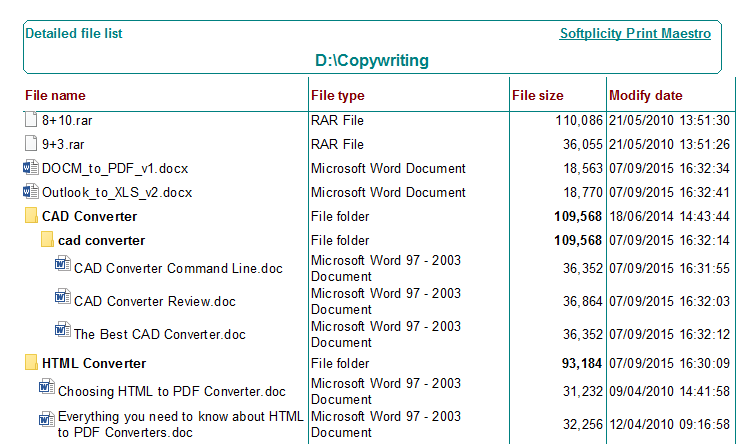
  • Detailed File List — file name, size, dates, and attributes in columns
  • Tree with Sizes — the folder hierarchy with cumulative size for each branch
  • Custom Report — pick any combination of columns and arrange them in any order

Download Free Trial — 30 Days

Windows 7/8/10/11 • No email required

How to Export Folder Contents to TXT — Step by Step

Step 1. Install Print Maestro

Download Print Maestro from the link above and run the installer. Setup takes under a minute. The program runs on Windows 7, 8, 10, and 11. No additional runtimes or frameworks required.

Step 2. Select the Source Folder

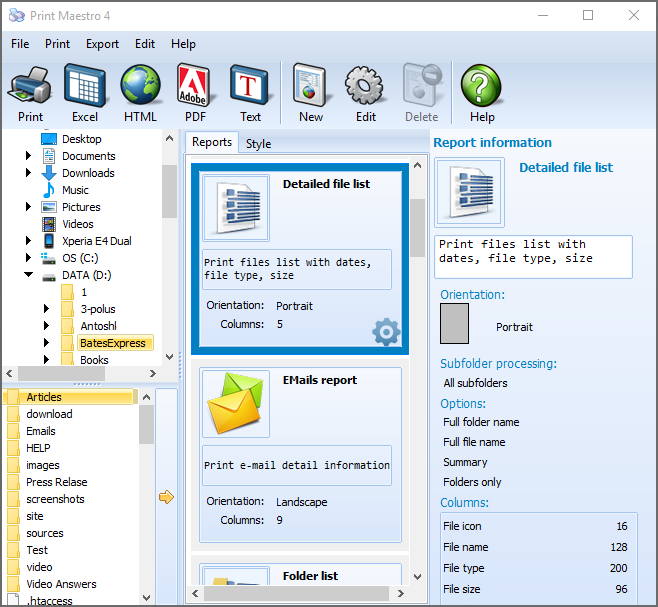
In the left panel you see the full Windows folder tree. Click the folder you want to export. If your target folder has nested subdirectories, enable Include Subfolders in the settings bar at the top. Print Maestro recurses through all levels and includes every file it finds.

Step 3. Choose the Report Type

The right panel shows the available report types. For a simple file listing, choose File List. For a directory tree, choose Folder Tree. For maximum detail (size, dates, attributes), choose Detailed File List. The preview area at the bottom updates instantly so you can see the result before exporting.

Step 4. Filter by File Type or Date (Optional)

Use the file mask field to narrow the output to specific extensions: for example, enter *.doc;*.pdf;*.xls to list only Office documents. You can also filter by file size range or modification date — useful when you need to find files older than a certain date or larger than a certain size.

Step 5. Preview the Report

Click Preview to open the paginated print preview. Scroll through the pages, verify that all expected files and folders are present. Adjust font size, column widths, and page margins if needed.

Step 6. Export to TXT

Click Export, select TXT as the output format, choose a save location, and click OK. Print Maestro writes the text file and opens it automatically. The file is plain text with tab-separated columns — ready to read, share, or import into another tool.

TXT Export vs. Other Methods

MethodWhat you getLimitations
dir /s > list.txt File names, sizes, dates in a raw text dump Cluttered with volume headers, date stamps, and summary lines. No column control. Hard to parse or share.
tree /f > tree.txt Folder hierarchy with file names No file sizes, no dates, no attributes. Just names and indentation.
PowerShell Get-ChildItem Flexible output with any file properties Requires scripting knowledge. Formatting output for sharing takes additional commands. No GUI preview.
Print Maestro Clean, structured text file with chosen columns, subfolder support, filtering, and preview Windows only. GUI-based (no command line).

Not Just TXT — Other Export Formats

TXT is the simplest output, but Print Maestro exports the same report to other formats as well:

  • PDF — a formatted, printable document with headers and page numbers. Good for sharing with people who do not need to edit the data.
  • Excel (XLS/XLSX) — opens in Excel with separate columns for each field. Sort, filter, add formulas, create pivot tables.
  • HTML — a styled table that opens in any browser. Publish to an intranet or attach to an email.
  • CSV — comma-separated values for database import, scripting, or any application that reads tabular data.
  • RTF / DOC — open in Word for editing, adding headers, or combining with other documents.
  • XML / SQL / DBF — structured formats for databases and custom applications.

When You Need a Folder-to-Text Export

  • Backup verification. Before or after a backup, export the folder contents to a text file. Compare the two lists later to confirm every file was copied. A text file is small enough to store alongside the backup itself.
  • IT inventory. Document which files sit on a shared drive, a server volume, or a USB device. Export to TXT and attach the listing to your asset management records.
  • Handoff documentation. When transferring a project folder to another team, include a file listing so the recipient knows exactly what is inside without opening every subfolder.
  • Storage cleanup. Export a detailed file list with sizes and dates. Open it in a text editor or Excel and sort by size to find the largest files, or sort by date to find the oldest ones.
  • Compliance and audit. Regulatory requirements sometimes demand a documented inventory of stored files. A dated text file listing serves as a record of what existed at a specific point in time.
  • Migration planning. Before moving files to new storage or a cloud service, export the folder structure to a text file. Use it as a checklist during migration and a reference after.

Why Print Maestro for Text Export

No Scripting Required

PowerShell and batch scripts can produce file listings, but setting up the right format, handling encoding, and exporting cleanly takes time and technical knowledge. Print Maestro does the same thing in a GUI: select folder, select report, click Export.

Subfolder Depth Control

You can set how many levels of subfolders to include in the report. Scan just the top level, or recurse all the way down. The depth setting is in the Edit menu — useful when the top-level structure is all you need.

File Filtering

Exclude system files, hidden files, or specific extensions from the report. When exporting a project folder, you probably do not need .tmp, Thumbs.db, or .DS_Store in the listing. Set a file mask and Print Maestro skips them automatically.

Instant Preview

See the report before exporting. If something looks wrong — too many files, wrong columns, unexpected subfolder — adjust the settings and preview again without creating a file you will delete.

Personal license starts at $39.90. Free 30-day trial with no restrictions — no email or credit card required.

Download Free Trial Buy Now — $39.90

Windows 7/8/10/11


quote

Print Maestro Customer Reviews 2026

Rate It
Rated 4.7/5 based on customer reviews
5 Star

"We document shared drive contents for compliance every quarter. Before Print Maestro I was running dir /s and then spending 20 minutes cleaning up the output in Notepad. Now I select the folder, choose Detailed File List, click Export to TXT, and the file is ready to attach to the audit report. Saves me real time every quarter."

5 Star James Whitfield IT Support Engineer

"When we hand off project folders to clients, we always include a text file listing every deliverable. Print Maestro makes this effortless. I point it at the project folder, enable subfolders, export to TXT, and drop the file into the delivery package. The filtering option is great for excluding temp files."

5 Star Claudia Reyes Project Manager, Ingenia Studios

"Solid utility for generating file listings. I use it to export folder contents before and after server migrations, then compare the two text files in a diff tool. The subfolder depth control is useful when I only need the top two levels. A command-line mode would make it even better for scripting, but the GUI is fast enough for my workflow."

4 Star Andreas Becker Systems Administrator

FAQ ▼

Print Maestro offers six built-in layouts: Folder Tree (indented directory hierarchy), Folder List (flat list of directories with sizes), File List (one file per line), Detailed File List (name, size, dates, attributes in columns), Tree with Sizes (hierarchy with cumulative folder sizes), and a Custom Report where you pick and arrange columns yourself.
Yes. Enable Include Subfolders to scan all nested directories. You can also set a depth limit to control how many levels deep the scan goes — for example, scan only two levels instead of the entire tree.
Yes. Use the file mask field to include only specific extensions (e.g., *.doc;*.pdf) or exclude file types you don't need. You can also filter by file size range or modification date.
The output is plain text with tab-separated columns. Each line represents one file or folder. The file opens in any text editor (Notepad, Notepad++, VS Code) and imports cleanly into Excel or Google Sheets.
Yes. Print Maestro exports the same report to PDF, Excel (XLS/XLSX), HTML, CSV, RTF, DOC, XML, SQL, and DBF. Select the format from the Export dialog — no separate tools needed.
The dir /s command produces a raw dump with volume headers, date stamps, and summary lines that need manual cleanup. Print Maestro generates a clean, structured file with only the columns you choose, supports filtering by file type and date, and lets you preview the result before exporting.
Yes, Print Maestro is a standard Windows desktop application. The installer is under 5 MB and runs on Windows 7, 8, 10, and 11. A 30-day free trial is included with no email or credit card required.


Start working now!

Download free trial and convert your files in minutes.
No credit card or email required.

⬇ Download Free Trial Windows 7/8/10/11 • 37 MB

Support
Print Maestro Preview1
Print Maestro Preview2

Latest News

Newsletter Subscribe

No worries, we don't spam.


© 2026. All rights reserved. CoolUtils File Converters

Cards