Logo
Home Products Support Contact About Us
arrow1 TIFF and PDF apps
div style="background: #88d7f4; color: white; padding: 1%;">

How to Re-arrange Pages in Multi-Page TIFF Files


A scanning bureau delivers a 200-page TIFF with the appendix pages mixed into the main body. A print shop receives a multi-page TIFF where pages 12–15 belong at the beginning. In both cases, the file is correct — but the page order is wrong. Fixing it in Photoshop means exporting every page, reordering manually, and reassembling the file.

Tiff Paging lets you re-arrange pages inside multi-page TIFF files without any image editing software. Drag pages to new positions, move blocks of pages between files, delete unwanted pages, and save — all in one window. Batch mode handles hundreds of TIFF files at once.

What You Can Do with Page Re-arrangement

  • Reorder pages visually — drag-and-drop thumbnails to move pages to any position in the file.
  • Move pages between files — extract pages from one TIFF and insert them into another.
  • Delete pages — remove blank, duplicate, or irrelevant pages from multi-page TIFFs.
  • Reverse page order — fix files scanned in the wrong direction (last page first).
  • Split and combine — break a large TIFF into smaller files or merge multiple TIFFs into one.
  • Rotate pages — fix landscape pages mixed into a portrait document without a separate editor.

Why Multi-Page TIFF Files Need Re-arranging

Multi-page TIFF is the standard format for scanned documents, faxes, and archival imaging. Unlike PDF, most image viewers cannot reorder pages inside a TIFF. When a duplex scanner feeds pages out of order, or when files from different sources are merged, the page sequence breaks. The data is all there — it just needs to be put in the right order.

Common situations that require page re-arrangement:

  • Scanner fed a stack in reverse order (page 50 is first, page 1 is last)
  • Pages from two separate scans need to be interleaved (odd pages from one file, even pages from another)
  • Cover page or separator sheets need to be moved or removed
  • A multi-page TIFF was assembled from individual files in the wrong alphabetical order
  • Quality control flagged pages that need to be replaced with re-scanned versions

How to Re-arrange Pages in Tiff Paging

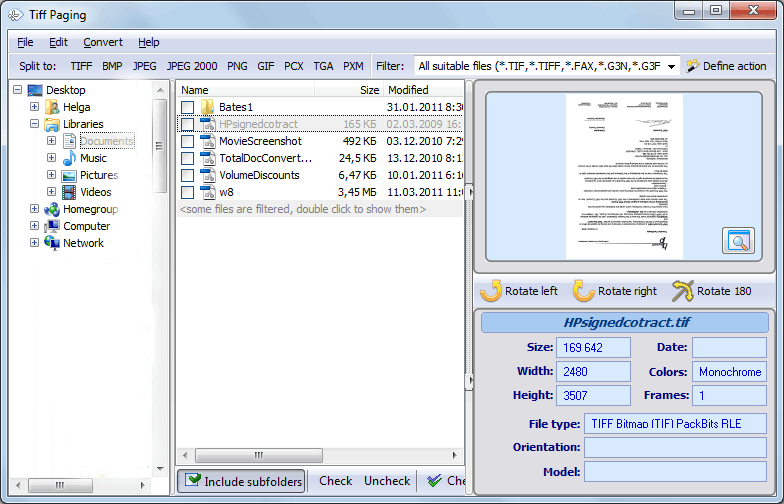
  • Step 1. Open Tiff Paging. Launch the program. The main window shows a file browser on the left and page thumbnails on the right.
  • Step 2. Load your TIFF file. Navigate to the folder containing your multi-page TIFF and click on the file. All pages appear as thumbnails in the preview area.
  • Step 3. Select pages to move. Click a page thumbnail to select it. Hold Ctrl to select multiple individual pages, or Shift to select a range.
  • Step 4. Drag pages to a new position. Drag the selected pages to the desired location in the thumbnail strip. The page order updates instantly in the preview.
  • Step 5. Delete unwanted pages. Select pages you want to remove and press Delete or use the toolbar button. Blank pages, separator sheets, or duplicates are removed from the file.
  • Step 6. Rotate pages if needed. Select pages that are sideways or upside-down and click the Rotate button. Choose 90°, 180°, or 270° rotation.
  • Step 7. Save the result. Click File > Save As to save the re-arranged TIFF to a new file, keeping the original untouched. Or save over the original if you prefer.

Download Free Trial

Buy Now — $39.50

Windows 7/8/10/11 • 30-day free trial

Page Operations at a Glance

OperationWhat It Does
Move pageDrag a page to a new position within the same file
Copy pageDuplicate a page and place the copy at any position
Delete pageRemove selected pages from the multi-page TIFF
Extract pagesSave selected pages as a separate TIFF file
Insert pagesAdd pages from another TIFF file at any position
Reverse orderFlip the entire page sequence (last page becomes first)
Rotate pageRotate selected pages 90°, 180°, or 270°
Split fileBreak a multi-page TIFF into individual single-page files

Re-arranging Pages vs. Other Approaches

MethodBatchVisual PreviewMulti-page TIFFNo Image Editor Needed
Tiff PagingYesYesFull supportYes
Adobe PhotoshopNoYesLimitedNo (requires Photoshop)
IrfanViewNoYesView only, no reorderYes
Windows Photo ViewerNoYesView onlyYes
Command-line (ImageMagick)YesNoRequires scriptingYes

When Do You Need to Re-arrange TIFF Pages?

1. Scanned Document Correction

Duplex scanners sometimes output pages in the wrong order — all odd pages first, then all even pages in reverse. Tiff Paging lets you interleave them into the correct reading order without re-scanning.

2. Legal and Medical Records Assembly

Case files and patient records arrive as separate scans from different departments. Pages need to be combined into a single TIFF in chronological order for filing or court submission.

3. Print Production

Print shops receive multi-page TIFFs where the cover page is at the end or the back matter is mixed with the front matter. Re-arranging pages in the file avoids reprinting or manual collation.

4. Archive Cleanup

Legacy document archives contain TIFFs scanned years ago with pages in random order. Before migrating to a document management system, page order must be corrected.

5. Fax Server Processing

Incoming faxes stored as multi-page TIFFs sometimes contain cover pages, confirmation pages, or blank pages that need to be removed or moved before forwarding to the recipient.

Why Choose Tiff Paging?

Visual Drag-and-Drop

See every page as a thumbnail. Drag pages to new positions with the mouse. No command lines, no scripting, no guesswork about which page is which.

Batch Processing

Apply the same operation to hundreds of TIFF files at once. Split all files in a folder, extract page ranges, or delete blank pages from an entire batch.

No Image Quality Loss

Tiff Paging moves pages within the TIFF container without re-compressing the image data. The pixel data stays identical to the original.

Works with Large Files

Multi-page TIFFs from high-resolution scanners can be hundreds of megabytes. Tiff Paging handles large files without running out of memory or crashing.

Additional Page Tools

Beyond re-arranging, resize pages, change color depth, adjust compression, and add headers or footers — all within the same program.

Download the free 30-day trial — no email or credit card required. A personal license costs $39.50 and includes one year of free upgrades.

Download Free Trial Buy License — $39.50


quote

Tiff Paging Customer Reviews 2026

Rate It
Rated 4.7/5 based on customer reviews
5 Star

"We receive scanned depositions as multi-page TIFFs and the page order is wrong about half the time. Before Tiff Paging, I had to export pages individually, rename them, and reassemble. Now I drag thumbnails to fix the order in a minute. The visual preview makes it impossible to put a page in the wrong spot."

5 Star Sandra Kimball Litigation Support Specialist

"Clients send multi-page TIFFs for print jobs and the cover page is often buried in the middle of the file. Tiff Paging lets me reorder pages without touching the image data, so there is zero quality loss. The fact that it handles 600 DPI files without slowing down is exactly what prepress work demands."

5 Star Henrik Dahlberg Prepress Technician

"Our scanner outputs even and odd pages in separate passes, so I end up with two TIFFs that need to be interleaved. Tiff Paging makes this easy. I open both files, select pages from one, and drop them into the other at the right positions. A task that used to take 20 minutes now takes two."

4 Star Lucia Ferreira Medical Records Clerk

FAQ ▼

Yes. Tiff Paging moves pages within the TIFF container without re-compressing the image data. The pixel content of each page stays identical to the original.
Open the file in Tiff Paging, select all pages (Ctrl+A), and use the reverse order function. The last page becomes the first, and so on. This fixes files scanned in the wrong direction.
Yes. Open both files, select the pages you want to move, and drag them into the other file at the desired position. The pages are inserted without affecting the rest of the file.
Yes. You can combine multiple single-page TIFFs into one multi-page file and arrange them in any order. You can also split a multi-page TIFF into individual single-page files.
Yes. Select any unwanted pages — blank, duplicate, or irrelevant — and press Delete. The remaining pages are renumbered automatically.
Yes. Tiff Paging can process hundreds of TIFF files in one operation. Apply the same split, merge, or page extraction to an entire folder of files.
Tiff Paging supports all standard TIFF compression methods: uncompressed, LZW, JPEG, CCITT Group 3, CCITT Group 4, and ZIP. The compression type is preserved when re-arranging pages.


Start working now!

Download free trial and convert your files in minutes.
No credit card or email required.

⬇ Download Free Trial Windows 7/8/10/11 • 4 MB
Get all CoolUtils products
for $99 only
read more

  (you save up to $500)


Support
Tiff Paging Preview1
Tiff Paging Preview2

Related Topics

How to Split Multi-Page TIFF to JPEG Images

Latest News

Newsletter Subscribe

No worries, we don't spam.


© 2026. All rights reserved. CoolUtils File Converters

Cards