Need help? Reach us at 

 +1 (855) 418-2323
Need help? Reach us at
+1 (855) 418-2323

 TIFF and PDF apps
You receive a folder with 500 scanned TIFF files. Some are compressed with LZW, some with CCITT Group 4, some are uncompressed. Your archiving system requires a specific compression method — but which files need to be recompressed? Opening each file in Photoshop or IrfanView and digging through properties is not an option.
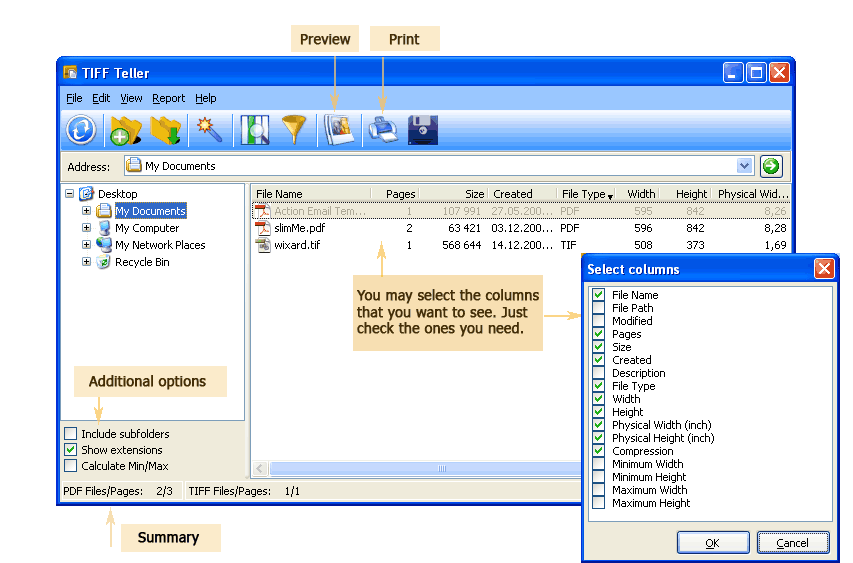
Tiff Teller reads every TIFF file in a folder and shows its compression type in a table. You see all files at once — no need to open them individually. The report can be exported to Excel, CSV, PDF, or other formats for further processing.
Quick answer: To check the compression type of TIFF files, launch Tiff Teller, open the folder with your TIFF files, and read the Compression column. It shows the exact algorithm for each file (LZW, CCITT Group 4, PackBits, None, and others), so you can sort by method and export the report to Excel or CSV in one click.
TIFF files support multiple compression algorithms, each designed for different types of images:
Follow these steps to identify the compression type of your TIFF files:
Besides compression type, Tiff Teller displays a complete set of technical parameters for each file:
| Parameter | Description |
|---|---|
| File Name | Name and extension of the TIFF file |
| Location | Full path to the file |
| Size | File size in bytes, KB, or MB |
| Page Count | Number of pages in multi-page TIFF |
| Width × Height | Image dimensions in pixels |
| DPI | Resolution (dots per inch) |
| Color Depth | Bits per pixel (1-bit, 8-bit, 24-bit, etc.) |
| Compression | Compression algorithm (LZW, CCITT, ZIP, None, etc.) |
| Creation Date | When the file was created |
| Modification Date | When the file was last modified |
You can customize which columns appear in the table and in what order. Hide the parameters you don't need and focus on what matters.
Government and corporate archives often require a specific compression format. CCITT Group 4 is the standard for black-and-white scanned documents. Tiff Teller lets you check if all files in a batch meet the requirement before ingesting them into the archive system.
Print shops receive TIFF files from multiple sources. Uncompressed files take longer to transfer and store. JPEG-compressed TIFFs may have artifacts visible in print. Tiff Teller identifies the compression of every file so the prepress team knows which ones need reprocessing.
After a bulk scanning job, you need to verify that the scanner used the correct settings. Tiff Teller shows compression, DPI, color depth, and page count for each file — making it easy to catch files that were scanned with wrong parameters.
Uncompressed TIFF files can be 10-50x larger than their compressed equivalents. Tiff Teller helps you find uncompressed files in a collection so you can recompress them with LZW or CCITT Group 4 and reclaim disk space.
When moving TIFF files between document management systems, you may discover that the target system doesn't support certain compression types. Tiff Teller gives you a full inventory of compression methods used across your file collection.
Point Tiff Teller to a folder and get a complete report on all files inside. No need to open files one by one. Processes hundreds of files in seconds.
Save the analysis table as CSV, XLS, PDF, DOC, or TXT. Import the CSV into Excel or a database for further filtering, pivot tables, or automated compliance checks.
Run Tiff Teller from the command line or .bat scripts for automated workflows. Schedule nightly scans of incoming document folders and generate reports without manual intervention.
Tiff Teller never modifies your files. It reads metadata without touching the image data, compression, or any other property of the original TIFF.
Multi-page TIFF files are fully supported. Tiff Teller reports the page count and analyzes the compression of each page in the container.
Generate a CSV report of all TIFF files in a folder:
TiffTeller.exe /src "C:\Scans\*.tif" /out "C:\Reports\tiff_report.csv"
Add this command to a .bat file and run it on a schedule. The command-line version supports the same parameters and export formats as the GUI.
Download free trial and convert your files in minutes.
No credit card or email required.

Related Topics
How to View the Number of Pages in Multiple PDF Files
