Need help? Reach us at 

 +1 (855) 418-2323
Need help? Reach us at
+1 (855) 418-2323

 File Converters TIFF and PDF apps Forensic Freeware
You need to publish Word documents on a website, feed them into a CMS, or process them through an XSLT pipeline — but DOC and DOCX files are not web-ready. Saving as HTML in Word produces loose, inconsistent markup that often breaks in XML-based workflows. Total Doc Converter converts Word files to valid XHTML — strict XML-compliant output that renders in browsers and parses correctly in any XML tool.
(includes 30 day FREE trial)
(only $49.90)
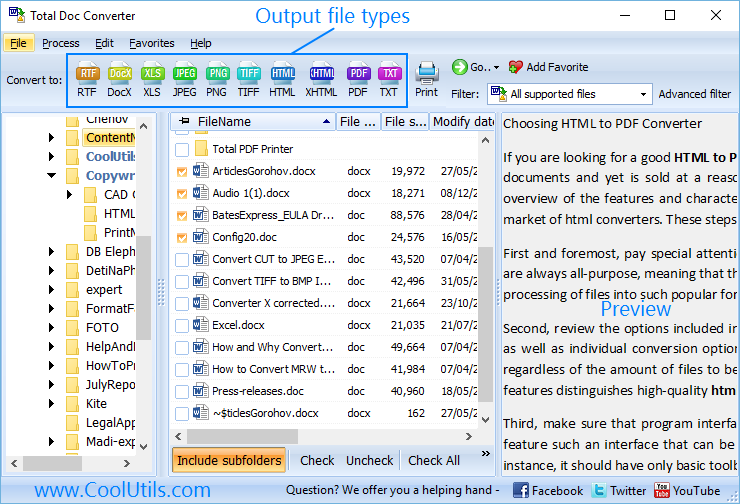
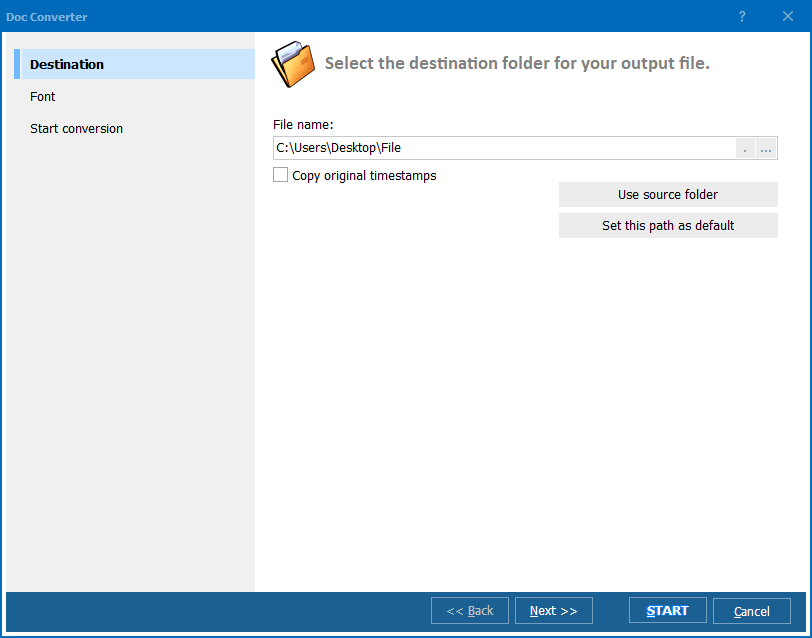
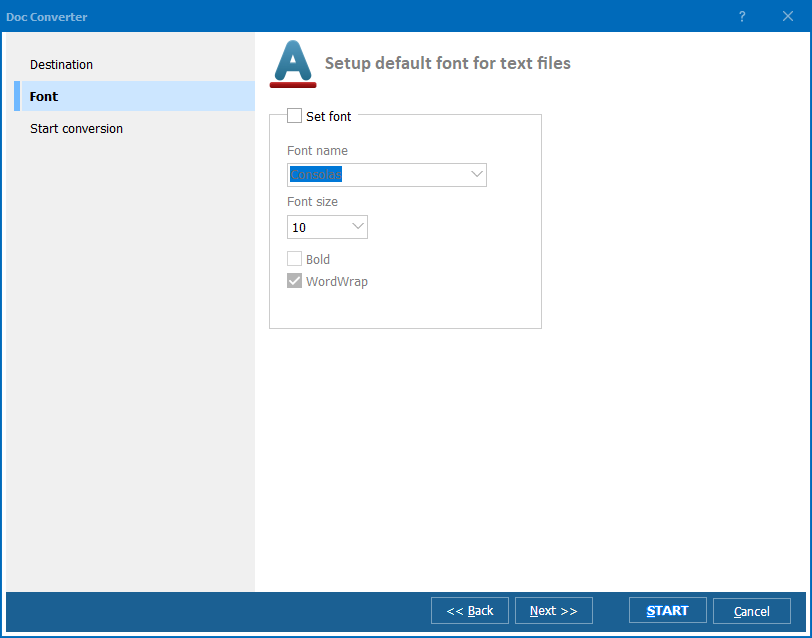
Quick answer: To convert Word to XHTML, launch Total Doc Converter, browse to the folder with your DOC or DOCX files, check the files or click Check All, click XHTML in the format toolbar, set the encoding and page layout, then press Start. The output is strict, W3C-valid XML that opens in any browser, and hundreds of files convert in one batch — offline, with no size limit.
DOC is a proprietary binary format Microsoft introduced in 1983. DOCX replaced it in 2007 as a ZIP-compressed XML package. Both carry rich formatting: fonts, tables, images, headers, footnotes, macros. Full rendering requires Microsoft Word or a compatible editor. These formats are designed for desktop editing and printing, not for web display or automated processing.
XHTML is HTML reformulated as strict XML. Every element must have a closing tag, attribute values must be quoted, tag names must be lowercase, and the document must follow a DTD. XHTML files render in any browser just like regular HTML, but they can also be parsed by XML processors, XSLT engines, and automated pipelines. This dual nature makes XHTML the go-to format when web content needs to be both human-viewable and machine-processable.
When you convert Word to XHTML, the document text, tables, and formatting become valid XML markup. The result opens in a browser and passes W3C validation. Unlike the "Save As HTML" output from Word — which is full of proprietary tags and missing closing elements — XHTML from Total Doc Converter is clean, standards-compliant, and ready for further processing.
Each Word file becomes a separate XHTML document. Original files remain untouched. The entire batch takes seconds, even for hundreds of documents.
Total Doc Converter includes a command-line interface for unattended processing. Convert a single file:
DocConverter.exe C:\Docs\report.docx C:\Output\report.xhtml -c XHTML
Convert an entire folder with wildcards:
DocConverter.exe C:\Docs\*.doc C:\Output\ -c XHTML
Save this command in a .bat file and schedule it with Windows Task Scheduler. New Word files that appear in the source folder get converted to XHTML automatically on a daily or weekly basis — no manual work required.
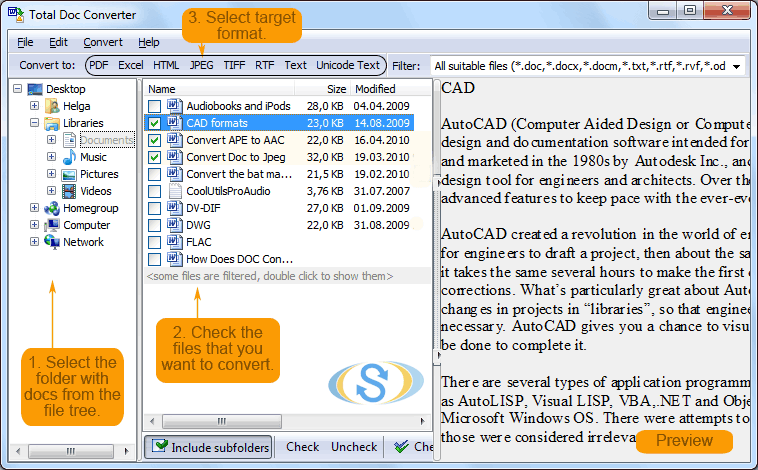
 Valid XHTML output. The converter produces well-formed XML that passes W3C validation. All tags are properly closed, attributes are quoted, and the document includes the correct DOCTYPE and XML declaration. The output works in browsers and XML processors alike.
Batch processing. Select a folder with 10 or 10,000 Word files and convert them all to XHTML in one run. No need to open each file in Word and re-save manually.
Clean markup. Word's built-in "Save As HTML" embeds proprietary Microsoft Office tags, conditional comments, and inline styles that inflate file size. Total Doc Converter strips out this clutter and produces compact, standards-compliant XHTML.
Formatting accuracy. Fonts, tables, images, headers, footers, and paragraph styles survive the conversion. The XHTML output matches the structure of the Word original.
No cloud uploads. All processing happens locally on your PC. Contracts, legal documents, and internal reports never leave your machine.
20+ output formats. Besides XHTML, convert Word to PDF, HTML, TXT, RTF, XLS, JPEG, TIFF, and more — all from the same tool.
| Feature | Online Tools | Total Doc Converter |
|---|---|---|
| File size limit | 10–50 MB | No limit |
| Batch conversion | 1–5 files at a time | Unlimited |
| Privacy | Files uploaded to cloud | 100% offline |
| XML validity | Often loose, broken HTML | Strict XHTML / W3C compliant |
| Speed | Depends on connection | Instant (local CPU) |
| Automation | None or paid API | Built-in command line |
| Formatting quality | Basic — complex tables often break | Full preservation |
| Pricing | Subscription or per-file fee | One-time $49.90 |
(includes 30 day FREE trial)
(only $49.90)
DocConverter.exe C:\Docs\*.docx C:\Output\ -c XHTML. Save it in a .bat file and schedule it with Windows Task Scheduler for automated processing.
Download free trial and convert your files in minutes.
No credit card or email required.

Related Topics
Word to HTML Converter